Documentation is in progress
🌿 App Design · 2026

Relax My Mind

Building an AI-powered calming app as a designer with no engineering background — proving that product thinking is the new superpower.

👤 Senior Product Designer 🤖 AI-assisted development 📱 iOS App 🧘 Mental Wellness
The Experiment

How far can a designer
go without touching code?

When AI coding tools started exploding, I noticed something interesting. Designers were suddenly shipping real products. Apps. Websites. Tools.

"I wanted to test one thing: how far can a designer go today without touching code? So I decided to build a real product from scratch using AI."

No Figma. No engineering background. Just product thinking, systems, and direction. This project became the proof of concept.

🧠 Product thinking ⚡ AI-assisted code 🗺️ Systems design 🚢 Solo builder
Finding The Problem

Distraction isn't
the same as calm.

I've always been interested in journaling, meditation, and calming techniques. But I kept noticing how people — including myself — actually deal with stress.

📱
The distraction trap
Most people regulate stress by distracting themselves:
  • Instagram and endless scrolling
  • YouTube rabbit holes
  • Mindless content consumption
Temporary relief. Not actual calmness.
🧘
Existing apps missed this
Meditation apps felt repetitive and emotionally disconnected. They focused on content consumption:
  • Guided meditations
  • Ambient music
  • Passive breathing exercises
Not active, physical interventions.

Real calming often comes from small physical actions — not passive content.

Moving to another room Changing environments Physical grounding Breathing differently

That became the opportunity behind Relax My Mind.

Competitive Landscape

Each covered a slice.
None served the whole.

Existing apps optimise for content. I wanted to optimise for state change.

Headspace & Calm
  • Beautiful, polished experience
  • Subscription paywalls for most content
  • Passive — you watch, you don't do
  • Not reactive to real-time emotion
Breathwork Apps
  • Scientifically sound techniques
  • Single-technique focus — repetitive
  • No emotional context or personalisation
  • Feels like a tool, not a companion
Relax My Mind
  • Reacts to your emotional state in real time
  • Short physical interventions, not long sessions
  • Sensor-aware — responds to your environment
  • Feels like a responsive companion
The Vision

Not another meditation app.
A responsive calming companion.

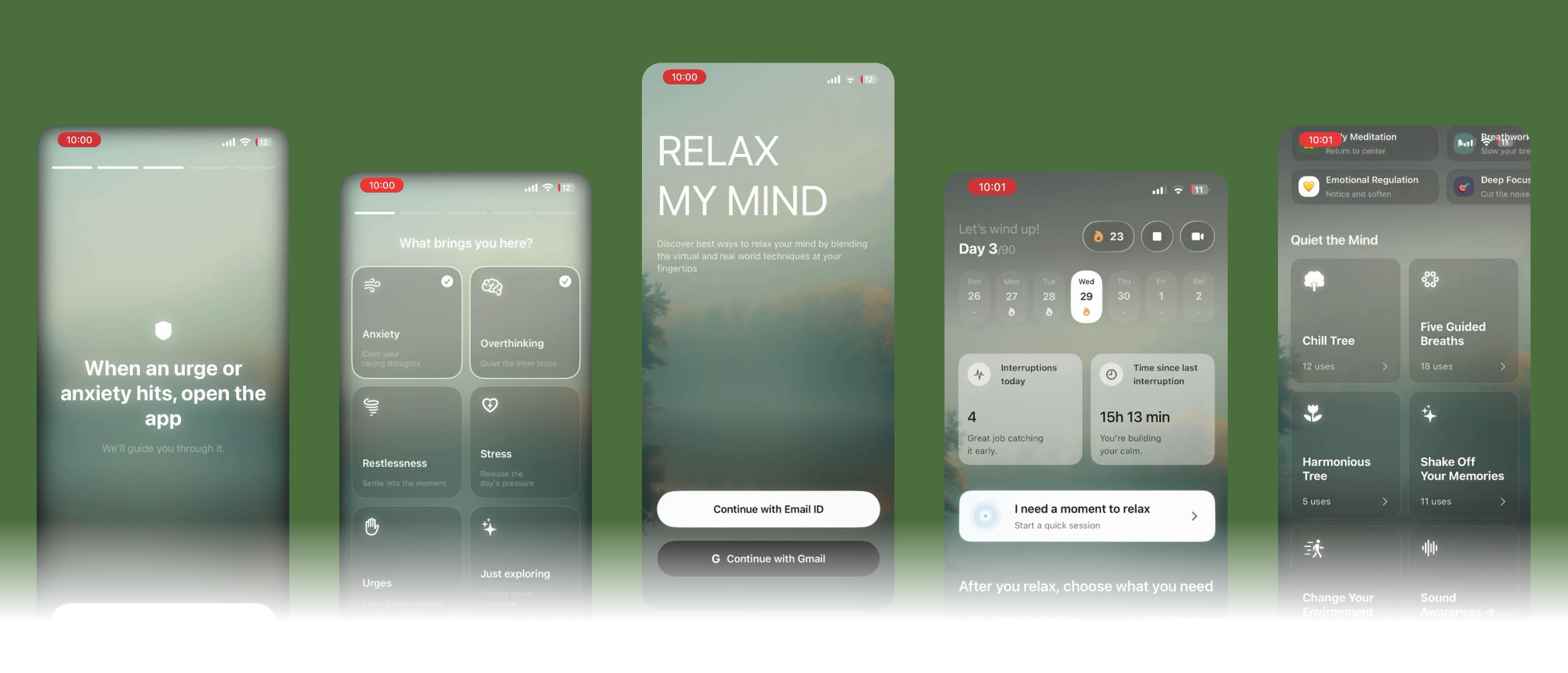
An app that reacts to your emotional state in real time. The core interaction was simple.

The Core Interaction

"Calm My Mind"

The user selects what they're feeling and how intense the emotion is. Using onboarding data and emotional inputs, the app suggests a sequence of short calming techniques.

🎭
Select emotion
What are you feeling right now?
📊
Rate intensity
How strong is it on a scale?
🌿
Get a sequence
Tiny, personalised interventions.

Not long sessions. Tiny emotional interventions. The goal isn't to become calm in 20 minutes — it's to shift 1% in the right direction.

Sensor-Driven Calming

Your phone already
understands your world.

I became obsessed with the idea that phones already understand context. So why weren't calming apps using that? I started experimenting with what was possible.

🎙️
Microphone-aware environments
If the app detects excessive noise, it can suggest the user move to a quieter place before beginning any technique. Context-first calming.
📐
Gyroscope-based interaction
Balance and tilt interactions as grounding exercises. Physical engagement creates a mind-body connection that passive audio never can.
🏃
Movement detection
Using motion data to understand if someone is pacing, restless, or still — and adapting the suggested technique accordingly.
🌍
Environment-aware suggestions
Time of day, location context, and ambient noise levels all feed into what kind of calming intervention is most likely to work right now.
"The product slowly started feeling less like a static app… and more like a responsive emotional assistant."
The Stack

No code background.
Three tools. One real product.

As someone from a pure design background, this completely changed how I think about building products.

💬
ChatGPT
Ideation, product thinking, and structuring emotional flows. Used for understanding user psychology and framing the right problems before building.
Claude Code + Codex
Frontend development and feature building. Writing production-quality code directly from product intent — no intermediate translation needed.
🗄️
Supabase
Authentication, backend logic, and user data — emotion logs, session history, onboarding preferences. The entire infrastructure layer.

A shift in how I think about design

I realised modern product design is becoming less about tools… and more about clarity of thinking. The constraint of "no engineering background" forced me to think in systems, not screens.

Visual Direction

The interface should
emotionally disappear.

The UI was intentionally minimal. I wanted the design to get out of the way so calm could take over.

🌿
Forest-inspired palette
Greens, muted earth tones, and soft natural gradients. Every color chosen to trigger a subconscious association with calm and nature.
No illustrations, very few icons
Complex visuals compete for attention. Simple line icons and whitespace communicate "this is a safe, quiet place."
💧
Soft, fluid interactions
No sharp transitions. Everything breathes. Gentle easing curves and subtle motion reinforce the emotional tone before a single word is read.
🤫
Minimal copy, big breathing room
Every screen has generous whitespace. When you're stressed, visual noise makes it worse. The UI itself should feel like a slow exhale.
The Insight

The shift that changed
everything mid-build.

"I wasn't designing screens.
I was designing emotional transitions."

Every interaction aimed to move the user from overwhelm to slight mental clarity. Even 1% calmer. That became the product philosophy — and it changed everything about how I made decisions.

🎯
Clarity of intent
Every feature had to answer: "Does this help someone feel 1% calmer?" If not, it didn't ship.
Speed over perfection
AI let me test assumptions in hours, not weeks. The learning came from building, not planning.
🔄
Systems thinking wins
Knowing what to build mattered more than knowing how. Design background = product clarity.
Outcome

Beyond the app.
A new way of thinking.

I tested the app with friends and colleagues. The early response was positive. But the real outcome was something bigger.

Early testers
12+friends & colleagues tested
What's next
App design & core flow complete
Exploring sensor-based interactions
Preparing for App Store submission
Long-term retention & emotional effectiveness study

The bigger proof

Designers today can move far beyond interfaces and become full product builders. AI hasn't replaced product thinking — it's amplified it. The designers who understand what to build will be the most valuable people in any room.

Priyanshu
Priyanshu Barnwal
Senior Product Designer · Zomato · 6 years experience